
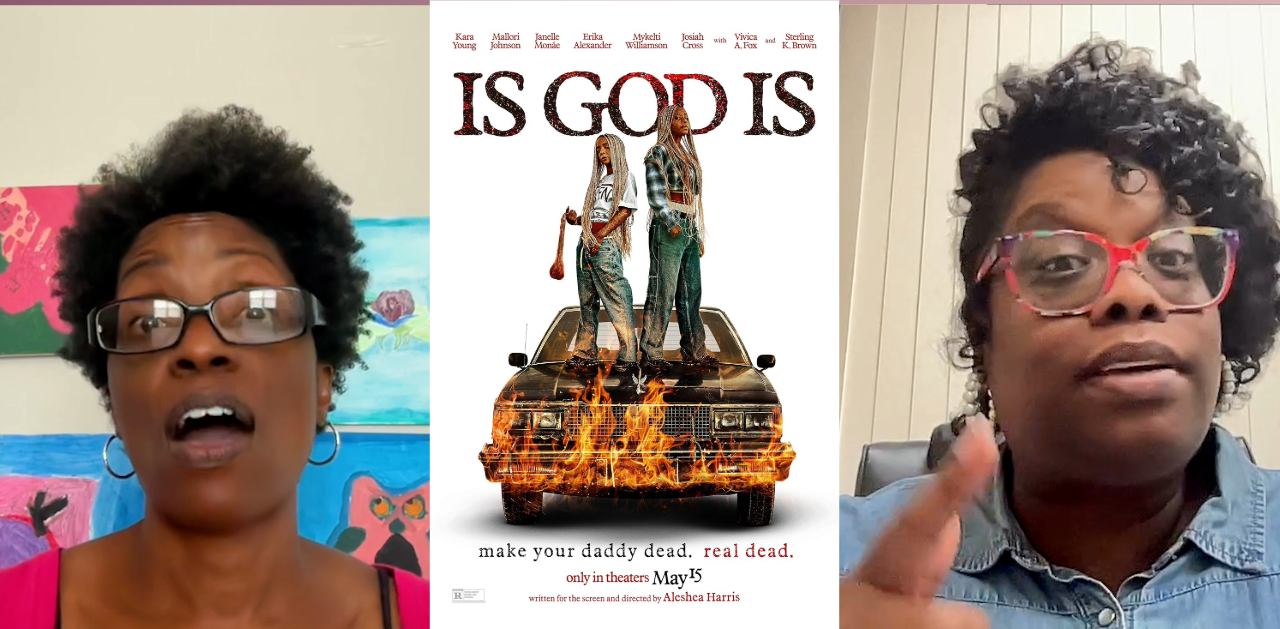
In Is God Is, the mother sends her daughters on a mission. Is the mission valid? Justified? Hmmmmm… yes and no. Should she ask her daughters to carry it out? Hell no.
But because Mama can be seen as God—even if she wasn’t there for them, as the mother in this story wasn’t for most of their lives—Mother still holds tremendous power. Most children, and in this case daughters, want to please Mama, even if she was a hellion or absent. The idea of the mother and the ultimate mother-daughter relationship is a goal for many of us involved in this dynamic. It can feel like designer shoes or the luxury house you’ve always had your eye on: a beautiful thing to have and hold, but for some of us, just out of reach.
We all look to the norm, to what society deems standard, to determine whether we’re measuring up. Are we doing well? Are we safe? Sometimes meeting the standard makes us feel normal. Missing the mark can make us feel out of place or unworthy.
There are many norms that vary across cultures. Marriage looks different. Food, clothing, and traditions differ. But one expectation remains remarkably consistent: motherhood and the mother-daughter relationship.
Growing up, my mama always had a soft spot for children who had lost their mothers. I feel the same way today—no surprise given her influence. As a dance mom, if any of us came across a daughter without a mother, we all seemed to instinctively “awww” her. Whether we realized it or not, we gave her a little more grace, offered extra snacks, checked in a little more often, and made sure she felt included.
Without ever discussing it, it was understood: a motherless daughter needs help.
Perhaps we are indoctrinated with the idea of the power of the mother and the mother-daughter relationship. Ultimately, we expect that Mother:
- Gives her body or her heart to bring her daughter here.
- Worries about whether her daughter has eaten enough.
- Encourages her first steps.
- Becomes her first cheerleader.
- Serves as her first teacher of right and wrong.
She is the person we first turn around to look at, searching for that nod of approval to determine whether we are doing something right or wrong. And if we sense we are doing it wrong, we often adjust ourselves until we receive her approval.
A mother is akin to a god-like figure. She is there to provide and protect, but she also holds the power to convict and condemn.
I have witnessed my entire life my mama, my aunts, and my grandmother loving their children fiercely. I’ve seen it for years in television and movies. Is the devotion of motherhood and the quest for the mother-daughter relationship nature or nurture? Perhaps some of it is cultural conditioning—our ideas of what mothers are supposed to be and what daughters are supposed to receive.
But I know for me, I do so love those girls. (And my boy.)
It’s true that the same power a mother has to encourage can also have the exact opposite effect, intentionally or unintentionally. My own children have told me, “Hey, the way you said that hurt my feelings.” Was that my intention? Hell no. But somehow it happened.
Has my own mama said things that hurt my feelings? Let’s just say there have been outfits I wore or times I gained weight that she made me aware she didn’t particularly like. Did she mean to hurt me? Probably not. Had those same words come from a stranger, I likely would have brushed them aside.
But her words have weight.
My words to my children have weight.
I realize that now.
But as a mother to daughters, I also realize that their words carry weight too. The difference is that mothers are expected to absorb those words, even when they land like a gut punch. If my daughters tell me my hairstyle is corny, my clothes are weird, refuse to take a selfie with me, or never respond to the TikTok I sent them, depending on the day, my feelings are hurt.
Do I say anything?
Nope.
We’ve been sold sugar and spice and everything nice, and we gladly buy into it because those little girls look so adorable dressed in pink. As mothers, we remember what it was like to be girls ourselves, and we delight in the idea of giving our daughters everything we wanted or everything our own mothers gave us.
Mothers are your entire world—whether they are there or not.
The idea of the loving mother-daughter relationship, with shopping sprees, mani-pedi days, and gossiping together like best friends, is so powerful that it exists as a standard deep in our subconscious. At least, that’s what came to mind when I had my daughters. And I am thinking even for Racine and Niya in the movie Is God Is when they agreed to carryout mama’s vengeance.
Therefore, I find it fitting that the twins in this film seek their mother’s love and approval even after not seeing her for most of their lives. They barely question why she has suddenly returned after all these years. And the mother, perhaps understanding the power inherent in this mother-daughter bond, seems to use it to her advantage.
As you get older, you learn to discern who is for you and who is against you. That clarity becomes blurry when it involves people who are close to us or people who, by societal standards, are supposed to love us. We often give them passes to say and do things we would never tolerate from others.
But eventually, whether as mothers or daughters, we have to learn to say no when we realize we are being played. We have to recognize when power is being used to manipulate rather than to love.
Because in this very delicate relationship, the line—and our ability to see it—can sometimes become invisible.
And perhaps that is exactly what god-like beings make possible.