
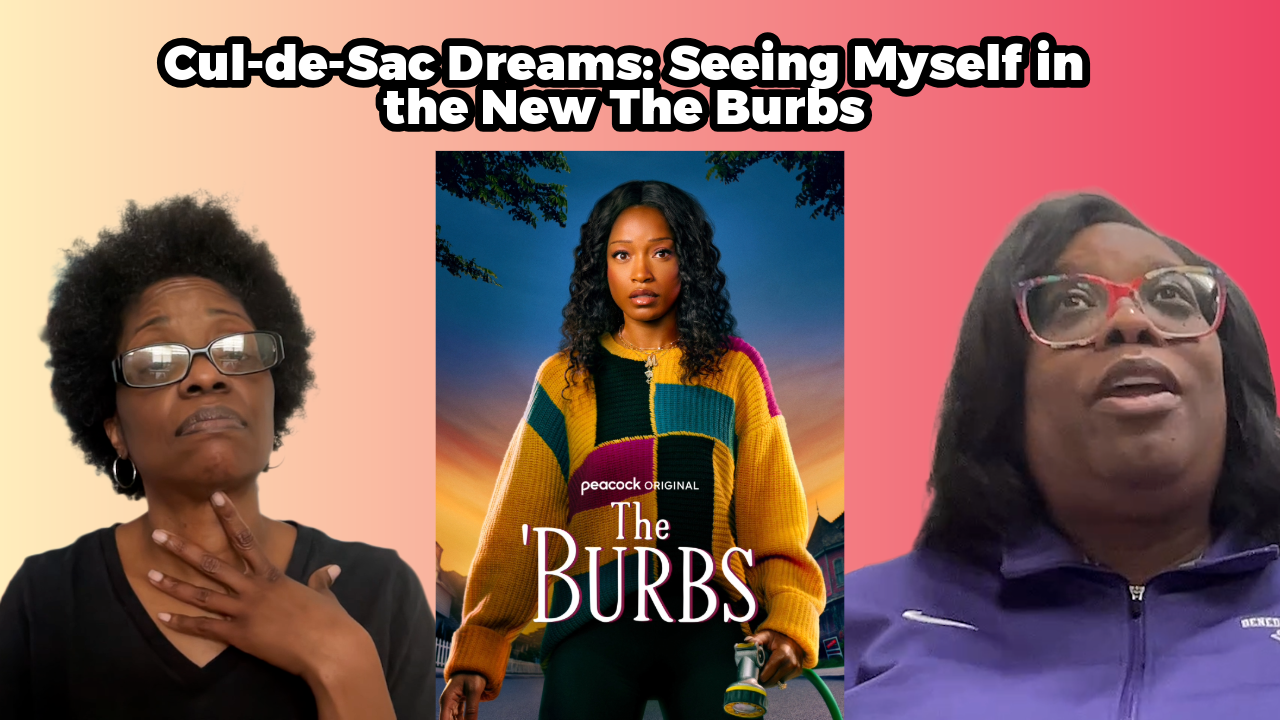

I used to think I lived in a circle.
That’s what I called the round stretch of pavement right outside my front door growing up. It wasn’t until high school—or maybe even college—that I learned that little circle had a name: a cul-de-sac.
It wasn’t until I became a mother that I realized cul-de-sac living was exactly what I wanted.
But then the real adult question came: Where would my cul-de-sac be?
Adulthood teaches you things school never mentioned, and one of those things is school districts. When you start thinking about raising children, cul-de-sacs aren’t just about quiet streets and kids riding bikes—they’re about standardized test scores, zoning maps, and which schools your children will attend.
And one thing becomes clear pretty quickly: the neighborhoods with the “better” school districts are often suburban communities where my children and I would likely be in the minority.
This tension is a major theme in the new TV series The ‘Burbs.
In the series, Keke Palmer takes on a version of the role originally played by Tom Hanks in the 1989 film **The ‘Burbs. The premise remains the same: bored, curious neighbors keep a close watch on the strange house down the street.
But the 2026 version adds something new for me—it adds recognition.
Palmer’s character, Samira, wears a bonnet around the house. She and her husband, Rob, have honest conversations about raising their baby in a neighborhood where there aren’t many people who look like him. The awareness of diversity—or the lack of it—comes up naturally in their conversations.
I appreciate the lighthearted way the show addresses this reality. It reminds me a bit of Black-ish. The topic is acknowledged in the first couple of episodes, but it doesn’t become the entire story. After that, the show moves on—and honestly, I’m grateful for that. I’m trauma-exhausted.
I’ve been fortunate to live in neighborhoods that were roughly 60–40 in favor of people of color. That balance happened almost by chance, but it meant my children were able to grow up with a diverse group of friends.
In the series, Samira quickly befriends a group of older white neighbors on her street. That’s probably the one part of the story that feels the least believable to me. Maybe it’s just my personality, but I’ve never found myself striking up friendships with older white strangers on my block.
Still, I admire Samira’s comfort level. And somehow, Palmer makes it work.
Her personality feels genuine, and by the end of the first episode, I believed her. I believed she could exist in this suburban world where people of different races and generations casually come together. Maybe that’s the magic of the writing, or maybe it’s Palmer’s natural charisma.
Either way, I’ll take it.
I’ll take a Black woman who has the option to be a stay-at-home mom, who can spend her time obsessing over suburban mysteries and neighborhood drama because that’s all she has to worry about.
Samira’s world is different from the one I grew up in.
And I’m okay with that.
I’ll watch that world again and again.