
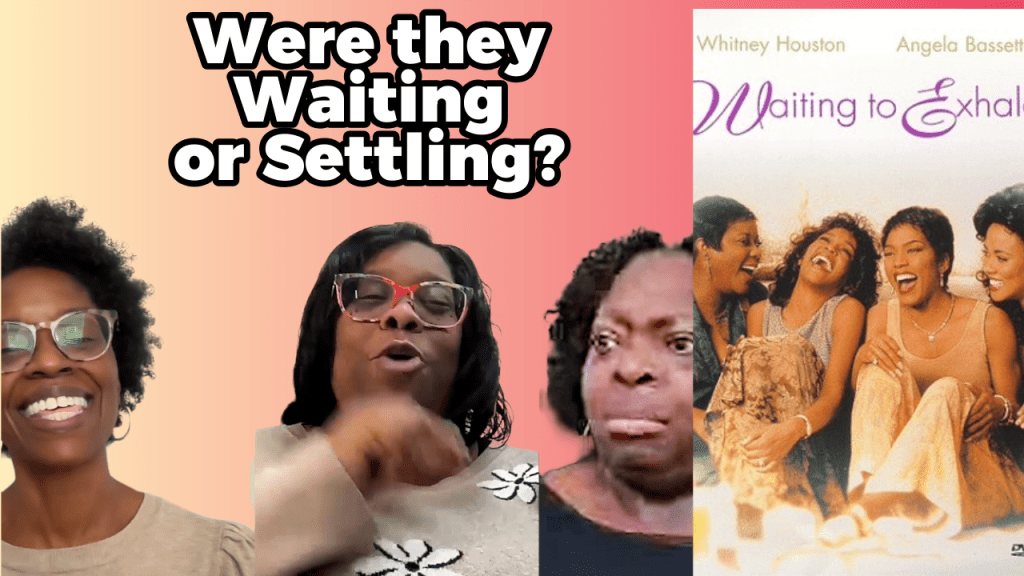
This past December marked the 30th anniversary of the film Waiting to Exhale. What Was She Thinking? revisited the movie with eyes that have now seen marriages, babies, and divorce. Collectively, we agreed: the film has aged well. Its themes—loneliness, desperation, self-love, perseverance—still ring true for anyone seeking a genuine, loving relationship.
What struck us most, though, was what still feels missing thirty years later.
There are still very few films that reflect Black women leading soft lives. Lives that move with less stress and more ease. Lives where we aren’t always the breadwinner, the fixer, the planner, or the one carrying the emotional and financial weight of everything. Lives where saving the world isn’t always our assignment.
Outside of the 1990s wave of Black love stories—Love Jones, The Best Man, Boomerang—we have yet to see a Black equivalent of The Notebook. In Variety magazine’s list of the 50 Best Romantic Movies, only five feature couples of color: Mississippi Masala, The Bodyguard, Past Lives, Love & Basketball, and Moonlight—with no mention of classics like Love Jones. If I’m looking to be inspired by a woman of color being fully pursued, respected, and cherished as the central storyline, the options are slim. But if I want to see her as the friend, neighbor, revolutionary, cynic, or comic relief? I have plenty to choose from.
Visuals matter.
We need to see women of color not only as successful businesswomen—that image is already abundant—but as women in healthy relationships. Women who are spoiled, nurtured, adored. Seeing that kind of love regularly would be a quiet revolution.
What Terry McMillan’s story did get exactly right is this: women have choices. Every woman in Waiting to Exhale had a choice about whether or not to pursue the men in her life. Yes, the men were flawed. But McMillan also seems to suggest that at some point, we must stop choosing—and allowing—them.
And here’s what I’ve come to understand: loving yourself is a lot like maintaining your ideal weight. You’re never safe to assume you’ve “arrived” and can relax. Just like physical health, self-love requires continued care—movement, nourishment, boundaries, attention.By the end of Waiting to Exhale, the women make better choices, and we leave them in a hopeful place. Like so many women—including myself—I hope they hold on to that love for themselves. Because the real work isn’t just choosing better once. It’s choosing yourself again and again.