
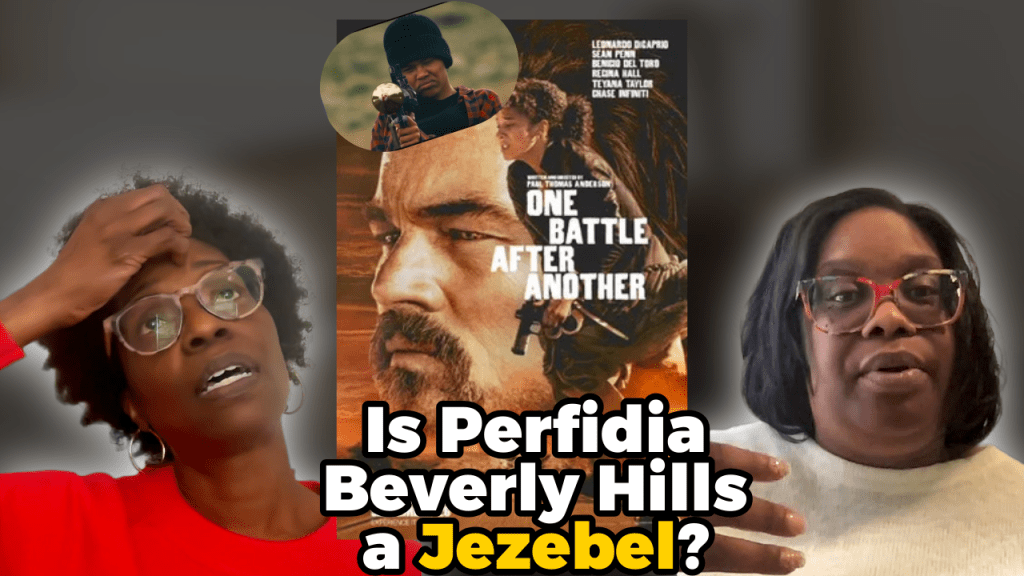
Did I just watch a visual representation of the Jezebel trope in Paul Thomas Anderson’s 2025 film One Battle After Another?
Written and directed by Anderson, the film presents itself as a story about a fractured father–daughter relationship, rooted in a lie about the whereabouts of the child’s mother. That mother—Perfidia Beverly Hills, played by Teyana Taylor—hovers over the entire narrative despite appearing only briefly in the first act. And yet, in those roughly 33 minutes, her body and sexuality are made to do an extraordinary amount of narrative labor.
At the start of the film, Perfidia and Pat/Bob (Leonardo DiCaprio) are romantically involved and appear to be co‑parents, united through their participation in a group called the French 75. The collective claims a mission of social justice—righting societal wrongs—while funding its work through morally dubious means. From the outset, the film positions Perfidia inside a contradiction: revolutionary politics on one hand, and deeply familiar racialized gender tropes on the other.
What stopped my review partner and me in our tracks were the repeated sequences that framed Perfidia as hypersexualized. She initiates sex minutes before a bomb is set to go off. She wants sex while Pat/Bob is actively assembling a bomb. She sleeps with Lockjaw to secure his silence. Each moment stacks on the last, creating an almost breathless insistence on her sexual availability.
That one night with Lockjaw—unknown to Pat/Bob—results in a child, and the remainder of the film largely revolves around Lockjaw’s obsessive search to locate that child and confirm paternity. Perfidia, meanwhile, disappears from the story altogether. Her presence lingers only through other characters’ fixation on her body, her desirability, and her perceived moral transgression.
In under forty minutes of screen time, Perfidia’s sexuality becomes her defining trait. The question then becomes unavoidable: is Anderson interrogating the Jezebel trope, or reinscribing it?
Historically, the Jezebel archetype has functioned as a racialized myth used to justify the exploitation of Black women—painting them as innately promiscuous, manipulative, and sexually dangerous. In that context, depictions are never neutral. Intent matters, but impact matters more.
In researching Anderson, I learned that he is married to a woman of color and has four children with her, and that this film reportedly took him nearly twenty years to write. By any measure, One Battle After Another is deeply personal. I do believe Anderson is attempting to grapple with race, power, and inequity. The film gestures toward this through its references to racist forefathers in a classroom scene, the gleeful cruelty of rowdy white men celebrating Perfidia’s capture, and Lockjaw’s need to keep his obsession with her hidden. These are not accidental choices—they are historical minefields.
And yet, I am left wondering whether the critique is legible enough to land.
Does presenting Perfidia almost exclusively through hypersexualized moments invite audiences to question the Jezebel trope—or does it simply reproduce it under the guise of provocation? Is the film trusting viewers to read critically, or overestimating how often that actually happens?
Scrolling through Reddit threads and Letterboxd reviews, I’m not convinced that most audiences are engaging with these questions at all. Without that critical recognition, what remains is a familiar image: a Black woman whose sexuality destabilizes men, families, and movements, while her interior life remains largely unexplored.
Still, I don’t dismiss the film outright. I appreciate that Anderson is willing to play in uncomfortable territory. These choices can open space for meaningful discourse about race, gender, and power—but only if viewers are equipped, and willing, to name what they are seeing.
So, is Perfidia Beverly Hills a Jezebel?
Or is she a mirror—held up not just to cinematic history, but to our collective discomfort with confronting how often these tropes go unquestioned?
The answer may say less about Anderson’s intentions, and more about whether we, as an audience, are ready to look closely enough.